
The short answer
A ductless mini-split is a good choice when you need heating and cooling in rooms or homes without ductwork, or in spaces your current system can't keep comfortable. We size the system to your rooms, check your electrical panel and mounting locations, and explain your options before any work begins.
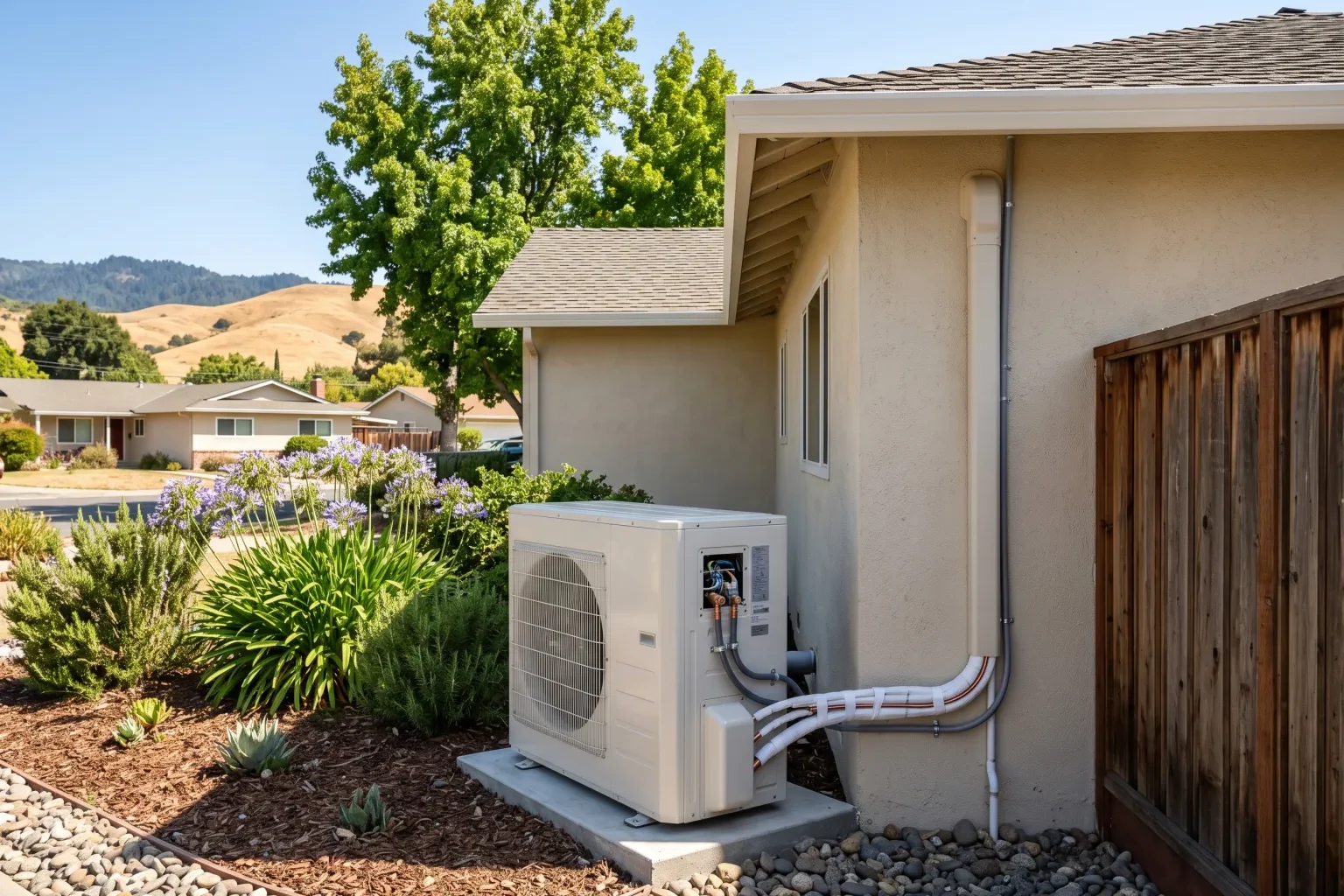
A ductless mini-split is a heat pump system with two main parts: an outdoor unit and one or more indoor units mounted on a wall, ceiling, or low on a wall near the floor. A small bundle of refrigerant lines, a drain line, and a control cable runs between them through a small hole in the wall, so no ductwork is needed. Mini-splits both heat and cool, and each indoor unit can be set to its own temperature. That makes them a practical fit for many South Bay homes: older houses built without ducts, room additions, converted garages, ADUs, and upstairs bedrooms that never feel right no matter what the main thermostat says. CoolVantage HVAC Service plans and installs mini-split systems for homeowners in San Jose and nearby cities, from a single-room setup to a multi-zone system that serves several rooms from one outdoor unit.
Signs a Ductless Mini-Split Makes Sense for Your Home
The Santa Clara Valley has dry summers and mild, damp winters, and inland and southern parts of the valley run noticeably hotter in summer than areas near the Bay. Many homes here were built with a wall furnace or no cooling at all, which worked until summers started feeling longer. These are the situations where homeowners most often call us about a mini-split:
- Your home has no ductwork, and adding ducts would mean tearing into ceilings, walls, or a tight crawlspace.
- You rely on window units or portable air conditioners that are noisy, block light, and only cool part of a room.
- One or more rooms run much hotter or colder than the rest of the house.
- You've added a room, finished a garage, or built an ADU that your existing system doesn't reach.
- Your wall furnace or baseboard heaters are old, and you want heating and cooling in one system.
- Family members want different temperatures in different rooms.
What We Check Before Recommending a System
A mini-split only works well when it's matched to the space. An oversized unit cycles on and off and leaves rooms clammy, and an undersized unit runs constantly on hot afternoons. Before we recommend equipment, we walk through the house and look at:
- The size and layout of each room you want to heat or cool, including ceiling height and open floor plans.
- Insulation, window size and direction, and how much afternoon sun each room gets.
- Your electrical panel, to confirm there's capacity for a new circuit or whether panel work is needed.
- Where the outdoor unit can sit with good airflow, reasonable distance from bedrooms, and access for service.
- Wall construction and the best path for the line set, so it's protected and tidy.
- Where condensate water will drain, by gravity or with a small pump.
- Your existing heating or cooling equipment and whether it will stay, be replaced, or work alongside the new system.
Repair, Replace, or Add: Your Options
If you already have a mini-split that isn't heating or cooling well, start with a diagnosis. Common problems such as a dirty filter or coil, a clogged drain line, a failed sensor, or a refrigerant leak can often be repaired. Replacement usually makes more sense when the system is older, parts are hard to find, a major component like the compressor has failed, or the unit was never sized correctly for the room. We'll tell you what we found and what each path involves so you can decide.
If you have a gas furnace, you don't have to replace it just because rules are changing. Bay Area Air District appliance rules do not require replacing working equipment; they apply only when an existing furnace or water heater fails or is replaced. Under Rule 9-4, natural gas furnaces manufactured from 2029 must meet a zero-NOx emission standard, which in practice points homeowners toward heat pumps when a furnace is replaced after that date. Some homeowners add a mini-split now for rooms that need cooling and keep the furnace until it reaches the end of its life.
For homes with no ducts, a multi-zone mini-split can serve as the main heating and cooling system. For homes with ducts in good shape, a ducted heat pump may be the better choice, and we'll say so if that's the case.
What Affects the Cost of a Mini-Split Installation
Every installation is priced after we see the home, because the details change the scope of work. The main factors are:
- How many indoor units you need, and whether one outdoor unit can serve them all.
- The capacity of the equipment, based on room size, insulation, and sun exposure.
- The style of indoor unit: wall-mounted, ceiling cassette, floor-mounted, or concealed ducted.
- The length and difficulty of the line set route, including runs through attics, crawlspaces, or multiple stories.
- Electrical work, such as a new circuit or a panel upgrade.
- Mounting needs for the outdoor unit, such as a pad, wall bracket, or stand.
- Permits required by your city.
How an Installation Visit Works
We keep the process straightforward so you know what to expect at each step.
- Assessment: we visit, look at the rooms and the factors listed above, and ask how you use each space.
- Written proposal: we explain the recommended equipment, where each unit will go, and the work involved, and we answer your questions before you commit.
- Scheduling and permits: we schedule the installation and handle permits your city requires.
- Installation: we mount the indoor and outdoor units, run and seal the line set, connect power and drainage, and protect your floors and furniture while we work.
- Startup and testing: we pressure-test and evacuate the refrigerant lines, start the system, and check that each zone heats and cools as it should.
- Walkthrough: we show you how to use the remote or thermostat, clean the filters, and spot early signs of a problem.