
The short answer
If your furnace won't heat, short-cycles, makes new noises, or smells unusual, it likely needs repair, and most of these problems come down to a fixable part. CoolVantage diagnoses furnaces in San Jose and nearby cities, explains your repair and replacement options, and gives you a quote before any work begins.
San Jose winters are mild and damp, but December and January nights still get cold enough that a furnace that won't start, keeps shutting off, or smells wrong is a real problem. CoolVantage HVAC Service repairs gas furnaces in homes across San Jose and nearby cities. We find out what's actually wrong, explain it in plain terms, and lay out your options before any work starts. If your furnace is a good candidate for repair, we fix it. If it isn't, we'll tell you why and explain what replacement would mean under current Bay Area rules.
Signs Your Furnace Needs Repair
In the Santa Clara Valley, furnaces often sit idle for much of the year. Problems tend to show up during the first cold week of fall, when the system runs for the first time in months. Some signs are minor annoyances. Others mean you should shut the system off and get it looked at.
If you smell gas or a carbon monoxide alarm sounds, leave the house right away. Call your gas utility or 911 from outside. Don't try to restart the furnace.
- The furnace won't turn on, or the blower runs but only cool air comes out
- Short cycling, where the burners light, run briefly, and shut off over and over
- Uneven heat, with some rooms warm and others cold
- Banging or booming at ignition, or squealing or grinding from the blower
- A burning dust smell that doesn't fade after the first few minutes of the season, or any smell of gas
- A yellow or flickering burner flame instead of a steady blue one
- An ignitor that clicks repeatedly without lighting
- Heating bills climbing even though you haven't changed how you use the system
- Soot around the furnace or vent, or a carbon monoxide alarm going off
What We Check During a Furnace Repair Visit
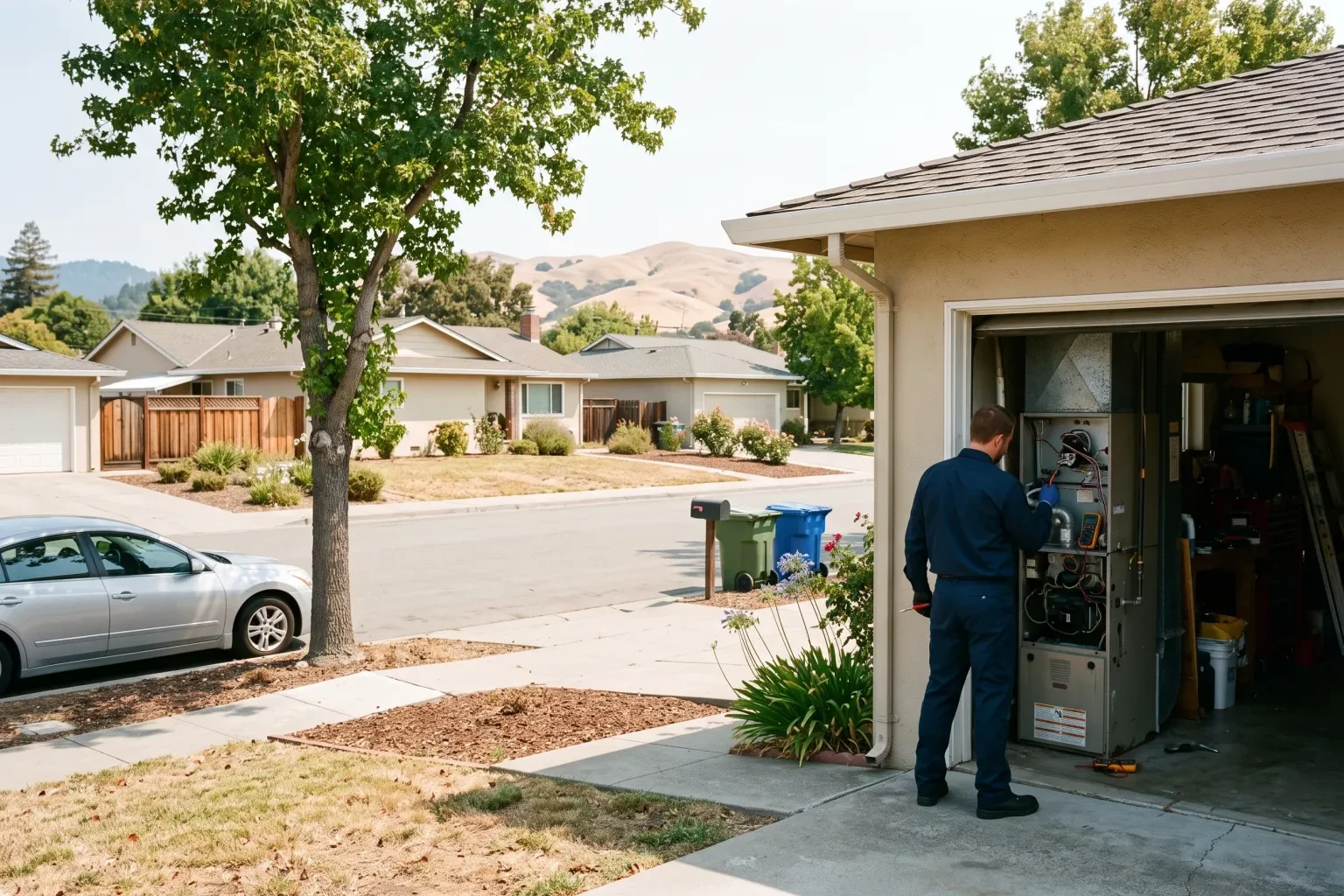
A repair starts with diagnosis, not guesswork. Our technician checks the system from the thermostat to the vent so the repair fixes the cause and not just the symptom.
We also test for carbon monoxide around the furnace and confirm that combustion gases are venting properly. If we find a safety issue, we'll show you what we found and explain why it matters.
- Thermostat settings, wiring, and batteries
- Air filter condition and return airflow
- Ignitor or pilot assembly and flame sensor
- Gas valve, burners, and flame quality
- Heat exchanger, inspected for cracks or signs of overheating
- Inducer motor, pressure switch, and venting
- Blower motor, capacitor, and belt where applicable
- Limit switches and other safety controls
- Control board error codes
- Condensate drain and trap on high-efficiency furnaces
Repair or Replace: Your Options
Most furnace problems are straightforward repairs. Common examples are a failed ignitor, a dirty flame sensor, a worn blower motor, or a bad pressure switch. Replacement becomes worth discussing in a few situations: the furnace is near the end of its expected life, it needs a major part like a heat exchanger, it has needed repeated repairs, or it can't keep the house comfortable even when it's working.
Bay Area Air District rules matter here, but they don't force anything on a working furnace. Under Rule 9-4, natural gas furnaces manufactured from 2029 on must meet a zero-NOx emission standard. In practice, that points homeowners toward heat pumps when they replace a furnace after that date. The rules apply only when equipment fails or is replaced. Nobody has to swap out a furnace that's running fine.
If you're weighing replacement, note that the federal 25C tax credit covered heat pumps placed in service before December 31, 2025. It isn't available for new installations now. BayREN and your local clean energy provider may offer heat pump or electrification incentives, but amounts and availability change by funding cycle. We confirm the current offer before including it in any quote.
We'll give you an honest read on whether a repair makes sense, and the decision is yours.
What Affects the Cost of Furnace Repair
We quote after diagnosis, so you know the scope of the work before we begin. Several factors affect the cost of a repair.
We don't start any work until you've reviewed the quote and approved it.
- Which part failed, and whether it's a common component or a major one like a heat exchanger or control board
- Part availability, especially for older or less common furnace models
- Furnace type, such as standard-efficiency, high-efficiency condensing, or variable-speed
- Where the furnace is installed (attic, crawlspace, closet, or garage) and how easy it is to reach
- Whether the visit happens during regular hours or after hours
- Whether related issues, like venting problems or duct leaks, need attention at the same time
How a Furnace Repair Visit Works
Here's what to expect from your first call to the finished repair.
Between visits, changing the air filter regularly and keeping the area around the furnace clear help prevent many of the problems we see.
- Scheduling: Tell us what the furnace is doing, and we'll set up a time for a visit.
- Diagnosis: The technician asks about the symptoms, inspects the system, and runs tests.
- Explanation and options: We explain what we found and give you a written quote for the repair. If they're relevant, we also cover replacement options.
- Repair: With your approval, we make the repair. If the part is on hand, this often happens during the same visit.
- Testing: We run the furnace through full heating cycles, check safety controls and venting, and confirm the house is heating properly.
- Wrap-up: We go over what we did and anything to keep an eye on going forward.
Furnace Repair by city
- Furnace Repair in Campbell
- Furnace Repair in Los Gatos
- Furnace Repair in Monte Sereno
- Furnace Repair in Santa Clara
- Furnace Repair in Saratoga
- Furnace Repair in Cupertino
- Furnace Repair in Milpitas
- Furnace Repair in Sunnyvale
- Furnace Repair in Los Altos
- Furnace Repair in Mountain View
- Furnace Repair in Morgan Hill
- Furnace Repair in Fremont